Home

Rhesus macaque

Macaca mulatta

RUDY

Conservation status: Least concern

Life span: 25 years

Total population: Unknown

Regions: China, India, Bhutan, Laos, Burma, Nepal, Bangladesh, Thailand, Vietnam, Pakistan, Afghanistan

Gestation: 5.5 months (164 days)

Height: 1.74 ft (M), 1.54 ft (F)

Weight: 17.0 lb (M), 11.8 lb (F)

TAXONOMY

Suborder: Haplorrhini

Infraorder: Simiiformes

Superfamily: Cercopithecoidea

Family: Cercopithecidae

Subfamily: Cercopithecinae

Genus: Macaca

Species: M. mulatta

Subspecies: M. m. brevicauda, M. m. lasiota, M. m. mulatta, M. m. sanctijohannis, M. m. vestita, M. m. villosa

Other names: rhesus monkey; west Chinese rhesus macaque; M. m. sanctijohannis: insular Chinese rhesus macaque or south Chinese rhesus macaque; M. m. vestita: Tibetan rhesus macaque

Divided according to country of origin, rhesus macaques are referred to as Chinese-and Indian- derived. Chinese-derived rhesus macaques include subspecies M. m. vestita, M. m. lasiota, M. m. sanctijohannis, and M. m. brevicauda. Indian-derived rhesus macaques are found in other countries besides India, but are still informally referred to as Indian-derived and include M. m. mulatta and M. m. villosa.

In breeding colonies at research centers in the United States, rhesus macaques have sometimes been bred separately according to their "country" of derivation but in other cases, crossbreeding has occurred, leading to some confusion about the taxonomic separation of individuals used in research.

Appearance

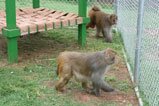
Rhesus macaques, both Chinese- and Indian-derived, range in color from dusty brown to auburn with little to no fur found on their reddish-pink faces. Their rumps are the same color as their faces and they have medium-length tails that average between 207.6 and 228.9 mm (8.17 and 9.01 in).

Males and females are sexually dimorphic, like other species of macaques, and males measure, on average, 531.8 mm (1.74 ft) and weigh, on average, 7.70 kg (17.0 lb) while females have an average height of 468.8 mm (1.54 ft) and an average weight of 5.34 kg (11.8 lb).

They are quadrupedal and, depending on the type of habitat in which they are found, can be predominantly arboreal or predominantly terrestrial. Rhesus macaques are also skilled swimmers and have been observed crossing bodies of water up to one kilometer (.621 mi) wide. When they are seen in the water they are usually searching for food, escaping from danger, regulating their body temperature, or playing. Swimming is a skill seen in infants as young as two days old.

RANGE

The only primates with a broader geographic distribution than rhesus macaques are humans. Rhesus macaques are found ubiquitously throughout mainland Asia; from Afghanistan to India and Thailand to southern China. M. m. vestita, M. m. lasiota, and M. m. sanctijohannis are found in western, central, and eastern China, respectively. Another Chinese species of rhesus macaque, M. m. brevicauda, is found on Hainan Island, off the southwest coast of China. The Indian-derived rhesus macaques are separated by region with M. m. villosa found in the Kashmir and Punjab region of India (the northern part of the country), Pakistan, and Afghanistan and M. m. mulatta found in India, Bhutan, Burma, Nepal, Bangladesh, Thailand, Laos, and Vietnam. It is likely that there will be additional subspecies added and M. m. mulatta will be reclassified into several more distinct subspecies based on genetic and morphological differences.

A free-ranging colony of rhesus macaques was established in 1938 on an island in the Caribbean. Introduced to Cayo Santiago, Puerto Rico, rhesus macaques have been studied under semi-natural conditions for almost 70 years and have provided an unprecedented resource for information about behavior, population demography, and long-term histories of individuals' social and physical development. Furthermore, with the establishment of this colony of free-ranging macaques came the birth of a new field of study, sociobiology, pioneered by Stuart Altmann who observed rhesus monkeys on Cayo Santiago and worked with notable sociobiologist E.O. Wilson.

Rhesus macaques are the most studied nonhuman primate, both in the field and in laboratory settings, though most of the field research comes from rhesus macaques in India. One of the notable early field researchers of rhesus monkeys is Charles Southwick, who began surveying them in 1959. Donald Lindburg has been another force in rhesus macaque studies, assessing the abundance of rhesus in India as well as reporting declines in the population which was important at the time of their export.

HABITAT

Because they are found in such a broad geographic area, it is difficult to concisely summarize the types of habitats rhesus macaques populate. In the most general terms, they are found in both tropical and temperate habitats including semidesert, dry deciduous, mixed deciduous and bamboo, and temperate forests as well as in tropical forests and mangrove swamps, usually at elevations from sea level to 2000 m (6561 ft), but they have been seen at elevations up to 4000 m (13,123 ft) in China and northeastern India. Rhesus macaques are also found in areas close to humans in urban settings or near cultivated fields.

In the northernmost part of their range, the rhesus of the Taihang Mountains in China live in a secondary deciduous forest at elevations between 300 and 1200 m (984 and 3937 ft) with a temperate climate and cold, snowy winters similar to the climate of the central, Midwestern United States. In this region, there are hot, rainy, and humid summers with severely cold and dry winters, and temperatures ranging between -20° C (-4° F) and 40° C (104° F) during the year. Annual rainfall averages 641 mm (2.10 ft), with the rainiest period lasting from June to August. This is similar to the climate of the region of Pakistan where they are found, but the habitat in Pakistan is dominated by mixed evergreen and deciduous forests that are highly disturbed. In their tropical range in China, and similarly in Burma, Laos and Thailand, the rainy season lasts from May to October with annual rainfall averaging 1575 mm (5.17 ft). Temperature is more stable in India and northern China throughout the year, ranging between 22° C (72° F) and 28° C (82° F). The habitat includes primary and secondary tropical and dry evergreen forests and bamboo forests.

In India, rhesus macaques are found in flat, cultivated areas, where agricultural fields dominate the landscape and in the plains, foothills and mountainous regions where habitat includes cultivated fields, tropical forests and dry, deciduous forests. Average annual rainfall ranges between 420 and 2150 mm (1.38 and 7.05 ft), depending on elevation, and annual range in temperature is between -4° C (25° F) and 48° C (118° F). During the hottest parts of the year, groups in the Himalayan region of India migrate to higher elevations where cooler temperatures persist throughout the summer months. In urban areas of India, they are found on roadsides, canal banks, in railway stations, villages, towns, and temples. It is estimated that 48.5% of rhesus macaques in northern India live in villages, towns, cities, temples and railway stations where they are in close and frequent contact with people at all times. About 37.1% of the population lives with some human contact on roadsides and canal banks and only 14.4% of the rhesus macaques in the northern part of the country live in isolation from humans and do not rely on them at all for food.

ECOLOGY

Rhesus macaques are exceptionally adapted to coexisting with humans and thrive near human settlement, in both urban and agricultural areas. It is impossible to characterize their "natural" diet without considering the impact of humans. Because they are found in higher densities in areas of human disturbance compared to forests, in some areas rhesus macaques derive, both directly and indirectly, a substantial part of their diet from human activities. In fact, up to 93% of their diet can be from human sources, either from direct handouts or from agricultural sources.

Rhesus macaques are omnivores and feed on a wide array of plant and invertebrate products. By raiding crops, they have access to a huge variety of cultivated fruits and vegetables, and in highly urban areas, they forage by picking through garbage.

Throughout their range and especially in India, they inhabit temples and are fed as a form of worship by local people. Some of the most common foods given to rhesus macaques in temples include bread, bananas, peanuts, seeds, other fruits and vegetables, and assorted miscellaneous foods like ice cream and fried bread. In less human-influenced areas, they focus on fruits, flowers, leaves, seeds, gums, buds, grass, clover, roots, bark, and they supplement their diet with termites, grasshoppers, ants, beetles, and mushrooms. Rhesus macaques also eat bird eggs, shellfish, and fish. During the driest parts of the year, they may even eat the dirt from termite mounds.

On Cayo Santiago, the rhesus macaques also consume dirt possibly because the mineral composition of the soil on the island is similar to pharmaceuticals used in humans to treat upset stomach. The Cayo rhesus may be eating dirt to relieve the discomfort associated with intestinal parasites. At higher elevations, where seasonal snowfall restricts food sources, rhesus macaques are restricted to eating the leaves of evergreen trees and bark as well as a few berries that grow in winter. During the winter months at high elevations, rhesus macaques suffer from food and climate stress and have higher levels of mortality if the cold weather lasts too long.

Home range size and day range length are dependent on habitat in rhesus macaques. Temple, village, and urban rhesus macaques have small home ranges between .01 and 3.0 km˛ (.004 and 1.16 mi˛) in size because they derive almost all of their food from human visitors leaving offerings, crop raiding, or opportunistic foraging on human byproducts. The day ranges for these urbanized areas are variable but the average is about 1.15 km (.715 mi). In more forested areas of India, home range size can be up to 15 km˛ (5.79 mi˛), but rhesus monkeys only move, on average, 1428 m (.887 mi) per day. In China, home ranges vary in size from .1 to .72 km˛ (.039 to .278 mi˛) near villages, while in mountainous areas, home ranges are much larger and span between 11 and 22 km˛ (4.25 and 8.49 mi˛) but average 16 km˛ (6.18 mi˛). Daily path lengths in this environment range from 1050 to 3500 m (.652 to 2.17 mi).

Both climate and season affect the timing of the onset of daily activities as well as the type of activities undertaken. In the warmest times of the year, rhesus macaques spend more time resting than during more temperate months. Home ranges of rhesus macaques overlap and groups have high frequencies of intergroup contact, which is characterized by generally mild social interactions. Across all habitat types, feeding and resting are the major activities of the rhesus macaques' day and they spend the rest of their time traveling, grooming, playing, and other activities.

Potential predators of rhesus macaques include raptors, dogs, weasels, leopards, tigers, sharks, crocodiles, and snakes.

SPECIAL NOTES

Because of their anatomical and physiological closeness to humans, the relative ease at which they can be maintained and bred in captivity, and the available supply from India, rhesus macaques have long been the nonhuman primate of choice on which to conduct research on human and animal health-related topics. Some of the direct benefits to human health that would not have been possible without the use of rhesus macaques include: development of the rabies, smallpox, and polio vaccines, discovery of rhesus factor in blood, creation of drugs to manage HIV/AIDS, understanding of the female reproductive cycle and development of the embryo, propagation of embryonic stem cells, and a number of behavioral discoveries.